Top 5 LinkedIn Inbox Management Tools in 2026
Published On June 7, 2025

Summary
- LinkedIn's native inbox is disorganized, causing users to miss opportunities in a channel where reply rates can be as high as 50%—far outperforming traditional email.
- The key limitations are a lack of prioritization, poor organization, and no built-in follow-up system, which leads to hours of wasted time and mental overload.
- This guide reviews the 5 best tools to solve these issues, from comprehensive inbox managers like Kondo to CRMs with messaging features like Breakcold.
- To reclaim up to 10 hours per week, professionals can use a tool like Kondo to organize their inbox with labels, reminders, and keyboard shortcuts, turning it from a source of chaos into a productivity hub.
You've opened LinkedIn to find dozens of unread messages from potential clients, candidates, and networking contacts - all mixed together in a chaotic stream. Important opportunities are buried beneath connection requests and group notifications, and you're spending precious hours each day just trying to sort through the mess. Sound familiar?
LinkedIn has become an essential business tool, but its native inbox leaves much to be desired. For professionals who depend on the platform for business development, recruiting, or networking, a disorganized inbox isn't just an annoyance—it's a bottleneck that costs time and money.
This guide explores the five best tools to transform your LinkedIn messaging experience from overwhelming to efficient, with a deep dive into how these solutions address the most common pain points.
Why Your LinkedIn Inbox is Holding You Back
LinkedIn has evolved into a goldmine for business opportunities, but its native messaging interface remains a major bottleneck for power users. The limitations of this system go beyond mere inconvenience - they directly impact your business results.
LinkedIn messaging is outperforming traditional email, with reply rates for outreach reaching up to 50% compared to just 0.5% for cold emails. With such high engagement rates, an inefficient inbox translates directly to missed opportunities and lost revenue.
The native inbox falls short in several critical areas:
- No Prioritization: A message from a potential six-figure client looks identical to a generic connection request
- Limited Organization: There's no way to categorize, label, or filter conversations systematically
- Inefficient Workflow: The average professional already spends 3.1 hours per day managing work messages; LinkedIn's interface adds to this burden with excessive clicking and scrolling
- No Built-in Follow-Up System: Users need a way to "track a response," but LinkedIn lacks native snooze or reminder functions
- Mental Overload: This disorganization leads to stress, anxiety, and the feeling of being overwhelmed
This sentiment is echoed by professionals across industries who rely on LinkedIn for critical business communications and feel that too many of their messages get lost.
The 5 Best LinkedIn Inbox Management Tools
The tools below range from comprehensive inbox overhauls to lightweight organizers, helping you find the perfect solution to transform your LinkedIn messaging from overwhelming to efficient.
1. Kondo - The Ultimate LinkedIn Inbox Experience
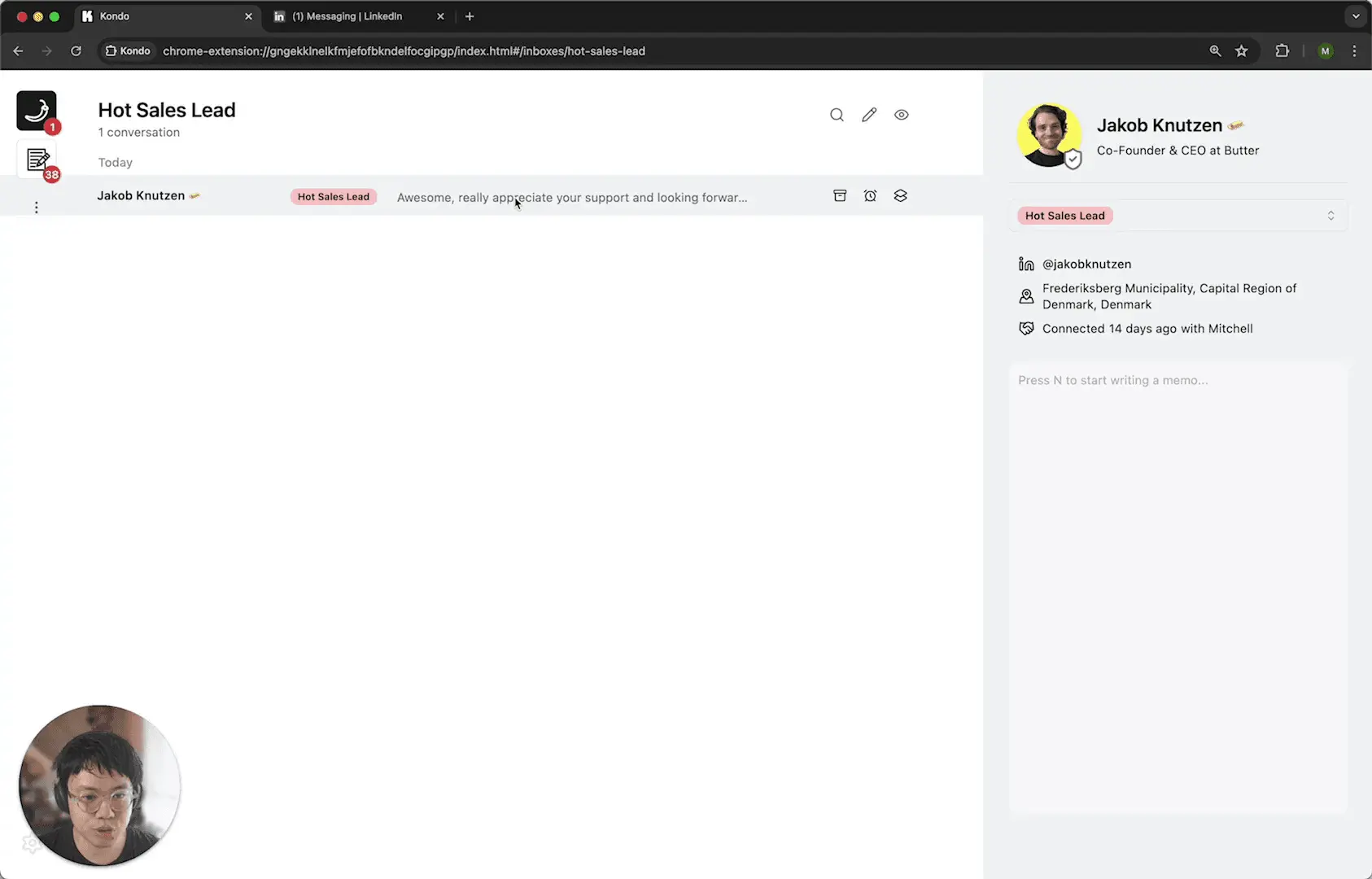
Kondo has quickly risen to become the leading solution for professionals drowning in LinkedIn messages. Often described as "Superhuman for LinkedIn," it transforms the platform's notoriously inefficient inbox into a streamlined communication hub designed for productivity.
Key features include:
Labels & Split Inboxes
Categorize conversations with custom labels such as 'Hot Lead,' 'Candidate,' or 'Client.' These labeled conversations can be viewed in separate, prioritized inboxes, preventing valuable messages from getting lost in the shuffle.
Reminders (Snooze)
With a simple 'H' shortcut, you can set follow-up reminders for any conversation. The message disappears temporarily and resurfaces at the top of your inbox when it's due, ensuring timely follow-ups without relying on external tools or memory.
Keyboard Shortcuts for Lightning-Fast Navigation
Kondo dramatically speeds up inbox processing with keyboard shortcuts that let you:
- Navigate your list (J/K)
- Archive messages (E)
- Set reminders (H)
- Apply labels (L)
- Open profiles (I) or posts (P)
Snippets for Consistent Communication
Create and manage snippets—reusable message templates that can be quickly inserted into replies. With variables like {firstName} for personalization, you can maintain consistency in your outreach while adding a personal touch.
CRM & System Integration (Business Tier)

Robust integration capabilities include webhook support, native connections with popular tools like HubSpot, Notion, and Google Sheets, and integration with platforms like Zapier and Make.com.
Users report saving up to 10 hours per week on inbox management. By implementing an 'Inbox Zero' philosophy, users experience reduced anxiety and capture significantly more opportunities that would otherwise be lost in the LinkedIn clutter.
Kondo offers several plans to fit different needs: the Basic plan costs $28/month (billed annually), the Business plan is $36/month (billed annually), and the Enterprise plan is $52/month (billed annually). All plans come with a 14-day money-back guarantee.
2. Botdog
Botdog positions itself as a lightweight LinkedIn inbox and relationship management tool designed for people who spend a lot of time in LinkedIn DMs and want better organization without full-blown CRM complexity.
Key Features
- Inbox organization: Tag conversations, add notes, and categorize contacts to keep track of relationships over time
- Follow-up reminders: Set reminders so conversations don't slip through the cracks
- Contact context: Store notes and interaction history alongside LinkedIn messages
- Keyboard shortcuts: Speed up inbox triage and navigation for power users
- Lightweight pipeline view: Track conversations through simple stages without committing to a full CRM
Drawbacks
Botdog is intentionally minimal, which can be a limitation for teams that need deeper collaboration features or CRM-grade reporting. There's no advanced automation, analytics, or multi-channel support, so it won't replace a sales engagement platform.
Some users also note that because it operates as a browser extension layered on LinkedIn, performance can depend on LinkedIn's UI changes, and the feature set is best suited for individual users rather than larger sales teams.
3. Breakcold
Breakcold positions itself as a dedicated CRM with LinkedIn inbox management features, particularly tailored for sales professionals and teams.
Key Features
- CRM Integration: Breakcold allows for tagging and organizing LinkedIn contacts directly within a CRM environment, making it easier to manage sales pipelines
- Automated Tasks: The platform includes automation capabilities for follow-ups and task management
- Team Collaboration: Features designed for teams to share and collaborate on LinkedIn conversations
Drawbacks
While Breakcold offers robust CRM features, new users often report that the interface can feel cluttered and overwhelming due to the number of features packed into the platform. The learning curve is steeper compared to more focused tools like Kondo.
Additionally, some users have noted that the LinkedIn integration occasionally experiences delays in syncing messages, which can be problematic for time-sensitive communications.
4. LinkedIn Sales Navigator
LinkedIn's own premium offering, Sales Navigator, includes enhanced messaging capabilities designed specifically for sales professionals looking to manage leads and prospects more effectively.
Key Features
- Native Integration: As a LinkedIn product, Sales Navigator operates seamlessly within the platform, eliminating concerns about third-party access or account restrictions
- Lead Management: The tool allows users to save leads and track updates, making it easier to manage relationships
- InMail Credits: Sales Navigator includes InMail credits for reaching out to prospects outside your network
- Advanced Search: Powerful filtering options help identify the right prospects to message
Drawbacks
The most significant limitation of Sales Navigator is its price point - starting at $99 per month, it's considerably more expensive than most dedicated inbox management tools. Many users also report that while it enhances LinkedIn's native features, it doesn't solve the core inbox organization problems that tools like Kondo address.
Many users find that they still need a way to track responses, as important messages can still get lost. Sales Navigator doesn't fully solve this core tracking issue.
5. Texts
Texts takes a different approach to LinkedIn message management by aggregating multiple communication channels into a single interface.
Key Features
- Channel Aggregation: Texts brings together messages from LinkedIn, WhatsApp, Telegram, and other platforms into one unified inbox
- Cross-Platform Search: Users can search across all their messaging platforms simultaneously
- Basic Organization: The tool offers some basic labeling and organization features
Drawbacks
While Texts solves the problem of managing multiple messaging platforms, it lacks LinkedIn-specific features. Users report that it functions primarily as a communication aggregator rather than offering dedicated LinkedIn inbox management tools.
The platform also doesn't provide the advanced labeling, snoozing, or keyboard shortcut features that power users need for efficient LinkedIn communication management. Integration with CRMs and other business tools is limited compared to specialized solutions.
How to Choose the Right Tool for You
When selecting a LinkedIn inbox management tool, consider these factors:
Message Volume: If you handle dozens of important conversations daily, a robust tool like Kondo is justified. For lower volumes, a lighter tool may suffice.
Integration Needs: If syncing conversation data to a CRM like HubSpot is critical, prioritize tools with strong native or Zapier integrations.
Team vs. Solo Use: Are you a solo founder or part of a sales team? Choose a tool with appropriate collaboration features.
Risk Tolerance: A common concern is whether using a third-party tool could lead to being banned from LinkedIn. While LinkedIn's User Agreement prohibits unauthorized automation and scraping, reputable productivity tools focused on organizing your existing inbox (not sending automated messages) are generally considered safe. Always review a tool's policies and avoid those that automate outreach or violate LinkedIn's terms.
Ready to Transform Your LinkedIn Inbox?
An unmanaged LinkedIn inbox isn't just a minor inconvenience—it's a liability that directly impacts your business results. The right tool transforms it from a source of stress into a powerful asset that helps you capture more opportunities and build stronger professional relationships.
While the tools above offer valuable features, Kondo stands out as the most comprehensive solution for professionals serious about transforming their communication. Its blend of labels, reminders, keyboard shortcuts, and CRM integration directly solves the core frustrations of the native LinkedIn inbox.
Stop letting a chaotic LinkedIn inbox dictate your success. It's time to invest in a tool that saves you hours, reduces stress, and ensures no opportunity slips through the cracks.
Ready to see the difference for yourself? Try Kondo and transform your LinkedIn workflow today. With a 14-day money-back guarantee, you have nothing to lose and a world of productivity to gain.
Frequently Asked Questions
What is the primary challenge with LinkedIn's native inbox?
LinkedIn's native inbox primarily struggles with a lack of robust organizational features, leading to a chaotic stream of messages where important opportunities can easily get buried. This makes it difficult for professionals who rely on LinkedIn for business development, recruiting, or networking to efficiently manage their communications and prioritize important conversations.
Why is effective LinkedIn message management crucial for professionals?
Effective LinkedIn message management is crucial because it directly impacts productivity, opportunity capture, and professional reputation. Without it, professionals risk missed opportunities from buried messages, delayed responses that can damage relationships, wasted time spent manually sorting through communications, and increased mental overload from a disorganized inbox.
How can I make my LinkedIn inbox more organized?
You can make your LinkedIn inbox more organized by using specialized third-party tools that offer features like labels, split inboxes, reminders (snooze functionality), and CRM integrations. Tools like Kondo are designed to categorize conversations, ensure timely follow-ups, and streamline your workflow, transforming your inbox from a source of stress into a productive communication hub.
What key features should I look for in a LinkedIn inbox management tool?
Key features to look for include the ability to label and categorize messages, set follow-up reminders (snooze), use keyboard shortcuts for faster navigation, create message templates or snippets, and integrate with your CRM or other business systems. The importance of each feature may vary based on your specific needs, such as message volume and workflow.
Which tool offers the most comprehensive solution for managing LinkedIn messages?
Kondo is highlighted as the most comprehensive solution for professionals seeking to transform their LinkedIn communication experience. It offers a strong combination of organizational features like labels and split inboxes, productivity enhancers like reminders and keyboard shortcuts, and valuable integrations with CRMs, addressing the core pain points of LinkedIn power users.
Can using a LinkedIn inbox tool really save me time?
Yes, using a dedicated LinkedIn inbox management tool can save significant time, with users of tools like Kondo reporting savings of up to 10 hours per week. These savings come from streamlined workflows, faster message processing through features like keyboard shortcuts and snippets, and reduced time spent searching for important conversations or manually logging data into CRMs.